Educational disclosure: This draft is general education and research, not individualized financial, legal, tax, credit, or investment advice. It contains no affiliate links or product recommendations.
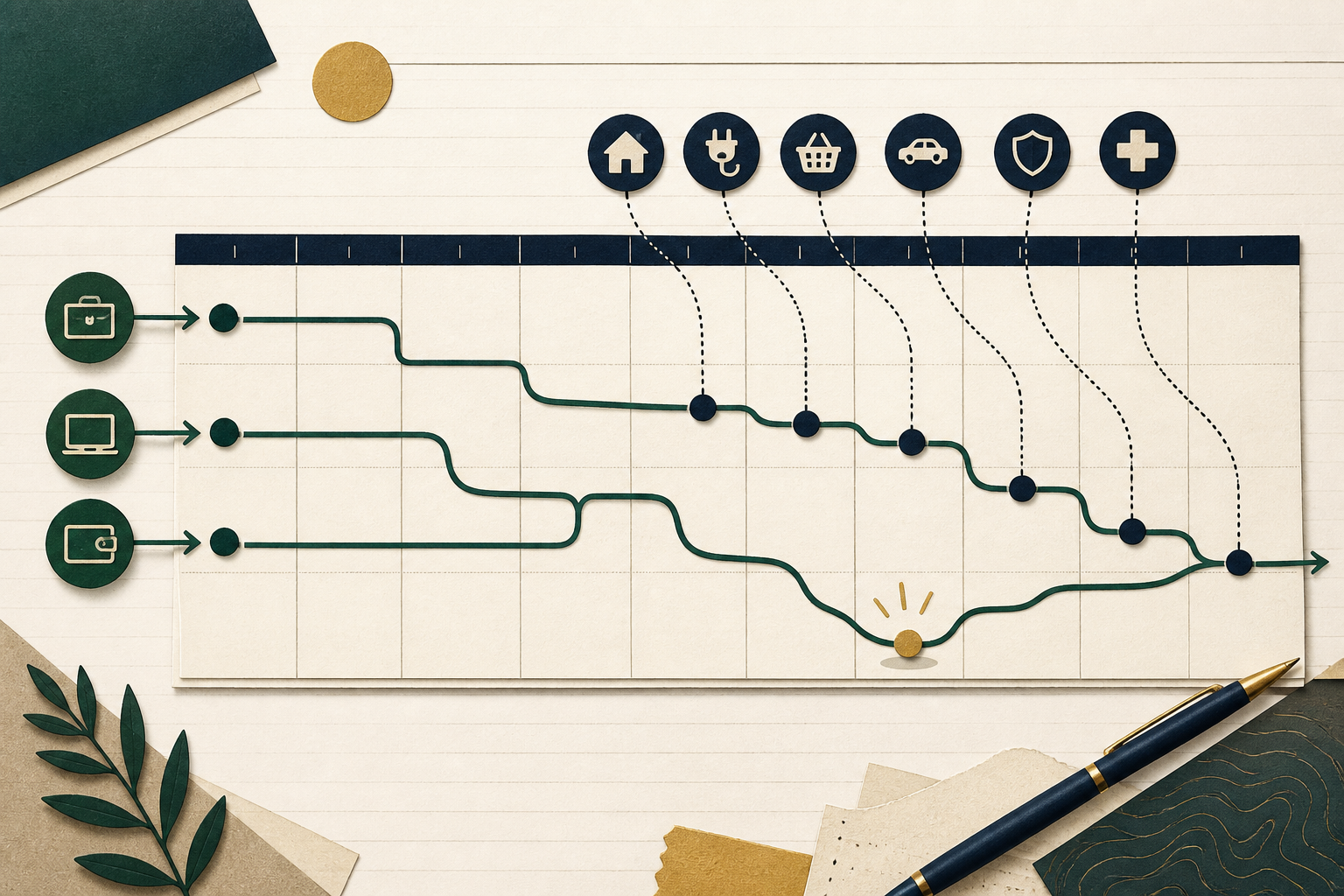
A monthly budget can say you have enough money and still leave you short on Wednesday. Cash flow is the order and timing of money entering and leaving your account. A simple 30-minute check can reveal the actual pinch point before a payment bounces, an overdraft fee lands, or a bill is missed.
What you need before you start
Gather the last month or two of checking-account activity, current balances, your pay dates, bills with due dates, and any expected deposits. Use the amount that has cleared or is contractually scheduled, not hoped-for overtime, marketplace sales, or a refund that has not arrived.
Build a running-balance calendar
Write every known deposit and essential payment in date order for the next 30 days. Start with today’s available balance, add money when it arrives, then subtract each planned payment. The lowest projected balance matters more than the month-end total because it shows where timing creates risk.
| Date | Item | Money in | Money out | Running balance |
|---|---|---|---|---|
| Today | Available balance | $0 | $0 | $___ |
| Aug. 29 | Paycheck | $___ | $0 | $___ |
| Aug. 30 | Rent or housing | $0 | $___ | $___ |
| Sep. 2 | Groceries and medication | $0 | $___ | $___ |
| Sep. 5 | Utility payment | $0 | $___ | $___ |
If the balance becomes negative, circle that date. You have found a scheduling problem to solve, not a personal failure.
Separate committed money from flexible money
Some money is already spoken for: housing, basic utilities, food, medication, transportation needed for work or care, insurance, and minimum required payments. List those first. Then add flexible spending, subscriptions, and nonurgent purchases. This is not a universal bill-priority rule. When a notice involves eviction, shutoff, repossession, foreclosure, collection litigation, or another legal deadline, read the actual notice and seek qualified local help promptly.
Check the automatic-payment trap
Autopay can be useful only when the account will have enough money on the withdrawal date. Make a separate list of automatic drafts, including annual or quarterly charges. Confirm the account, amount, due date, cancellation terms, and whether a change must be requested several days early. The CFPB explains that consumers should receive authorization terms for preauthorized electronic fund transfers and can stop a scheduled payment by notifying their financial institution in time, subject to applicable rules and circumstances.
Choose one action for the lowest-balance date
Do not try to repair the whole month at once. Ask which action best reduces the immediate risk: move a payment date, call a biller about an affordable arrangement, pause a nonessential expense, use a legitimate local-assistance resource, or change the timing of a planned purchase. Get any arrangement in writing and record the new date. Do not agree to a payment you cannot realistically maintain simply to end a difficult call.
Make the next check easier
Keep the same calendar and update it once or twice each week. Add the next payday, each fixed bill, an estimated grocery amount, and one irregular cost you can see coming. A 15-minute routine is more useful than a detailed file that is never reopened.
Use the calendar to ask better questions
A cash-flow calendar does not tell you what choice to make. It gives you better questions before the deadline arrives. Is the withdrawal date the real problem? Does a biller offer another due date? Can a purchase wait until the next deposit? Is there an expense that is actually quarterly or annual and needs its own line? Keep the original statement, agreement, or notice next to the calendar so the amount and consequence are not based on memory.
If income changes from week to week, build the first version around the lowest reliable amount and update it when money actually arrives. Treat a larger deposit as a revision, not as permission to pre-spend it. That conservative approach can feel slow, but it prevents a plan from depending on money that never clears.
Related reading: Build a Bare-Bones Budget and A Financial Reset Checklist When You Are Behind on Bills.
Sources
- Consumer Financial Protection Bureau, automatic payments from a bank account
- Consumer Financial Protection Bureau, budgeting resources
Human review required before publication: Verify current consumer-protection rules, local assistance references, all links, and any personal examples.