
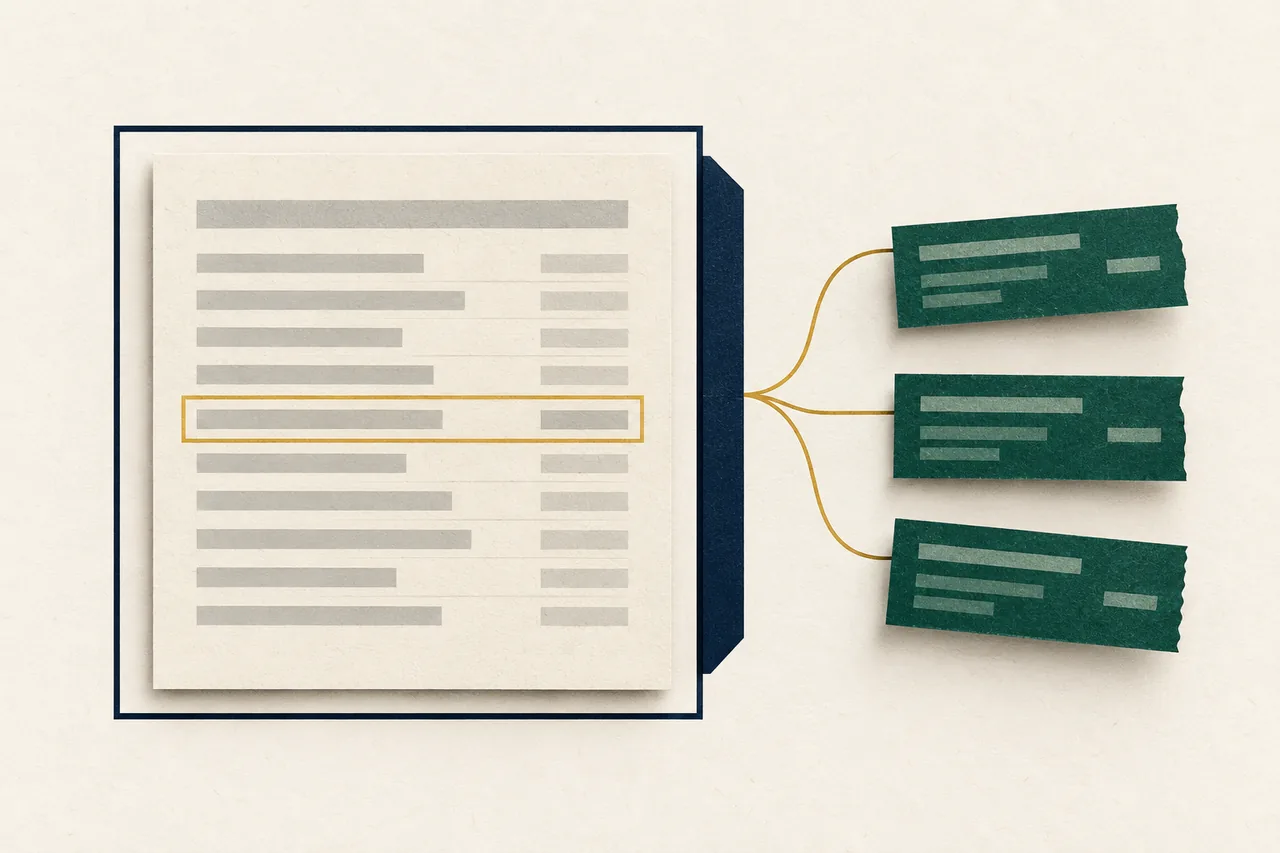
Before paying a credit card bill, check the billing period and due date, distinguish the minimum payment from the statement and current balances, and reconcile the posted transactions. Then flag unfamiliar charges, missing payments or special terms before confirming the payment instruction. A balance that adds up is not proof that every charge is yours.
This guide provides a six-field review sheet and a hypothetical calculation for an existing U.S. consumer revolving credit card. It does not choose a payment amount for your household. Keep the statement and account details private; a worksheet needs only enough information for you to identify the card.
Which dates should you check first?
Find the billing-cycle closing date and payment due date, then check when your chosen payment method will be received or credited. The closing date identifies the statement snapshot. The due date identifies the payment deadline. A new purchase after closing belongs to later account activity, even when it already appears in your account.
Open the actual statement, not just the balance tile in an app. Match it to the correct card and month. If you have several cards from the same issuer, use a private nickname and the last four digits to avoid reviewing one account and paying another.
Copy the due date into your bill calendar alongside the amount still required and the funding account. Record an existing scheduled payment separately from a reminder. A calendar entry means you remembered the obligation; it does not prove you submitted an instruction or that the issuer received money.
Check the payment instruction
Read the issuer’s instructions for the method you will use, including any cutoff and processing conditions. If bank bill pay sends a payment, its delivery timing may differ from a payment initiated at the card issuer. The autopay guide helps separate those routes. Before adding a manual payment, check whether another payment is already scheduled and ask how it affects the automatic amount.
What is the difference between minimum, statement and current balances?
The minimum payment is the required periodic payment shown for that bill. The statement balance is the amount outstanding at the cycle’s closing date. A current balance reflects more recent posted account activity and may differ from that snapshot. Confirm how your issuer labels each figure, particularly if the card has an installment or promotional feature.
The CFPB’s periodic-statement rule identifies the closing-date balance and other statement disclosures. Those fields serve different purposes. The smallest figure is not automatically a payoff amount, and the largest visible figure is not automatically the amount required for this particular bill.
Payments after closing can affect what remains to be paid, while the saved statement still shows its original figures. Check the issuer’s updated minimum remaining and payment status rather than repeating a payment solely because the PDF has not changed. An expected refund or pending payment needs confirmation before you treat an obligation as satisfied.
When recording the figures, preserve both the label and date. “Balance $600” is ambiguous. “Statement balance $600 at October 2 close” and “current posted balance $650 checked October 10” describe two different views. If a special adjusted balance appears, ask what it means for your account instead of substituting one generic definition.
A six-field statement-review worksheet
Copy these fields into a private note. Use the issuer’s labels and add a date to anything you check online. You are building a record of what you verified, not recreating an entire bank statement.
- Identity and period: private card nickname, last four digits, billing-period start and close, statement date.
- Deadline and payment route: due date, relevant method/cutoff instructions, funding account, scheduled payment reference.
- Amount labels: original statement balance and minimum, updated remaining minimum, current posted balance with time checked; any issuer-defined adjusted amount.
- Balance movement: previous balance, posted payments and credits, purchases or other debits, fees and interest.
- Exceptions: unfamiliar item, missing payment, pending refund, special balance or unclear interest; evidence and question for the issuer.
- Next action and proof: ordinary payment check, billing-error follow-up or affordability call; contact date, confirmation reference and next review date.
Keep the exception field short and factual. “$40 credit expected but not on statement” is a useful question. “The bank stole $40” asserts something the record has not established. Store receipts and confirmations privately alongside the note, without placing account numbers in a public comment or an AI prompt.
Mark a field confirmed only when you have checked the corresponding evidence. If one item is unresolved, retain its amount and status instead of changing the worksheet so its total agrees. The point is to expose a difference you can investigate.
How can you check whether the statement balance adds up?
Start with the previous balance, subtract posted payments and credits, then add posted purchases, other debits, fees and interest. Compare that result with the closing balance using the statement’s own categories. Include every category the account actually uses; a simple purchase-only formula will miss a cash advance, transfer or adjustment.
Match the previous balance to the prior statement’s closing amount. Then compare the current statement’s payment entries with your confirmations. A payment requested just before closing might not appear where you expect; check its posted date and status rather than assuming it failed or counting it twice.
For purchases, compare amount and merchant information with your records. A recognizable brand may use a different billing name, but an unfamiliar description still deserves a check. Record duplicates, credits that should have appeared and amounts that differ from receipts in the exception field.
Treat reconciliation as two checks: whether the numbers sum correctly, and whether the entries themselves are correct. Passing the first does not settle the second. For example, a duplicate purchase can be included perfectly in the issuer’s arithmetic while still being an item you need to question. Ask about the specific entry instead of disputing an entire balance merely because one line needs clarification.
Hypothetical example: the statement and current balance differ
Assume an ordinary revolving account with no cash advances, balance transfers or installment features in this example. Every figure is invented. The October 2 closing statement lists the following activity:
- Previous balance: $860.
- Payments posted during the cycle: $180.
- A separate merchant credit posted during the cycle: $40.
- New purchases during the cycle: $220.
- Interest: $18. Fees: $0.
The closing statement balance is $860 minus $180 minus $40 plus $220 plus $18, or $878. The payment and merchant credit are separate rows here. If your own statement groups them into one $220 total, subtract that total once; do not also subtract its component rows.
Now assume that, after closing, a new $75 purchase and a $100 payment both post. With no other activity, the current posted balance becomes $878 plus $75 minus $100, or $853. The saved statement still shows the historical $878. These figures can both be correct because they refer to different times.
This calculation does not establish the amount needed to preserve a grace period, clear a promotional feature or satisfy today’s remaining minimum. Those depend on the actual account and how payments are applied. Use the issuer’s current payment information and ask about anything unclear.
The worksheet should preserve the $878 statement snapshot and the later $853 figure, with dates, instead of overwriting one with the other. It should also show that the $100 payment is posted. If it were only pending, the example’s second calculation would not describe confirmed posted activity.
What should you learn from the interest section and repayment box?
Check which balances and rates produced interest, then read any repayment estimate as an estimate with assumptions. APR means annual percentage rate; it is not a monthly charge percentage. A minimum-payment or three-year comparison box is not a recommendation for what your household can afford, and it does not include future purchases in its projection.
The CFPB explains the repayment-box assumptions. Copy the estimate and its assumptions into your note if useful, but keep it separate from the required minimum. Disclosure exceptions exist, so an absent comparison box is not by itself proof of an incorrect statement.
Check interest conditions before assuming a full payment stops interest
A purchase grace period generally depends on the card providing one and the account meeting its conditions, including not carrying a balance. Cash advances generally work differently. Paying only the minimum does not establish an interest-free purchase period. The CFPB’s grace-period explanation describes these limits.
Interest can reflect daily balances and different transaction rates, rather than one calculation using the final statement balance. The CFPB explains those calculation differences. If an interest charge is unclear, ask which balance, dates and rate produced it. For promotions or previously carried balances, request an account-specific explanation instead of assuming one payment amount settles every feature.
What should you do if something is wrong or the payment will not fit?
Separate a possible billing error from a cash shortage. For an error, preserve evidence and use the issuer’s formal billing-error instructions. For an unaffordable payment, contact the issuer about options. An unanswered question is not proof that a charge is wrong, and a hoped-for change is not a confirmed payment arrangement.
Call through a verified account channel promptly about an unfamiliar charge or missing credit. The CFPB’s error-review guide explains why a written follow-up matters. Under the formal billing-error rule, the creditor must receive a qualifying written notice no later than 60 days after transmitting the first statement reflecting the alleged error. A missing credit is tied to the statement where it should have appeared. Use the disclosed dispute address; an electronic route counts when the issuer specifies that it accepts that route for written notices.
Keep the statement, notice and delivery evidence. Do not wait for a merchant refund conversation to finish before checking the formal deadline. Ask how the disputed item affects your required payment and existing autopay; continue handling undisputed obligations. Accepted goods of poor quality may involve a different process, so do not apply one billing-error rule to every merchant problem.
If funding is the problem, the CFPB recommends contacting the card company promptly. State the amount you can afford, the timing and the change you are requesting. Ask for written confirmation of any terms. Use the cash-availability worksheet and debt-priority guide to examine the wider household picture. For the broader cluster, return to Start Here.
