
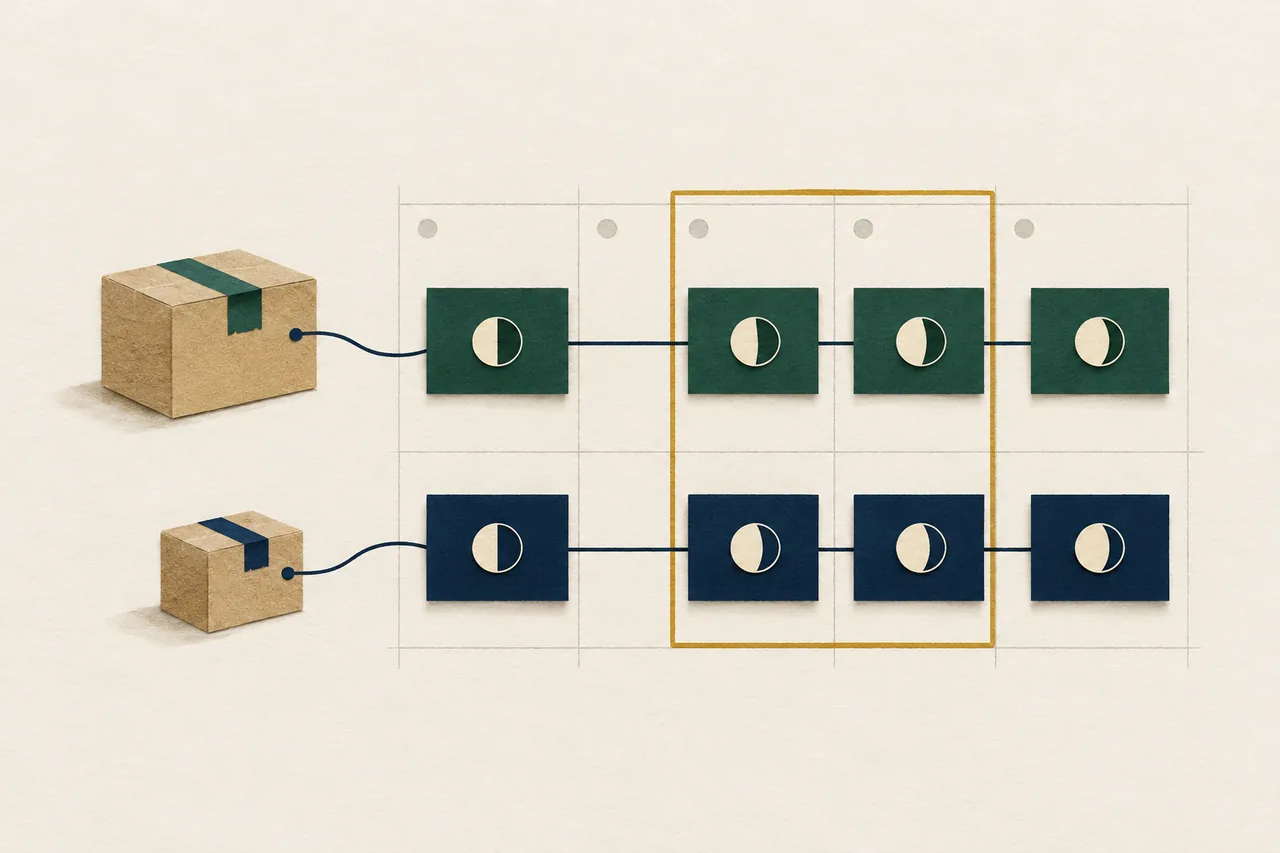
Track buy now, pay later payments in two places: a purchase register showing the full obligation, and a dated cash-flow calendar showing each unpaid installment. Count each actual cash movement once. A small payment shown at checkout does not describe all the money already committed to that purchase.
This guide is for organizing existing plans. It provides a private tracker and a hypothetical two-purchase example, rather than recommending a lender or another purchase. Buy now, pay later, often shortened to BNPL, is installment borrowing. Four payments are common, but schedules, interest and fees vary. Use your own agreement, not a generic pay-in-four assumption. The CFPB explains the basic arrangement.
What should you record for each BNPL purchase?
Record the full purchase amount, the lender, every remaining payment amount and date, and the account or card being charged. Keep a separate unpaid balance so a near-term calendar does not hide obligations due after your next paycheck. Start from the lender’s actual schedule and reconcile it against payments that have cleared.
A merchant name alone may not identify the company collecting installments. Give each purchase a private label, such as “replacement appliance, October,” and pair it with the lender and order reference. Keep sensitive account numbers out of a shared spreadsheet; the last four digits are usually enough for your own routing notes.
Confirm the payment route
Mark whether the lender withdraws from your bank account or charges a credit card. A card-funded installment increases the card obligation and may affect available credit; the eventual bank cash movement follows the card’s own bill. Record that route separately instead of pretending the lender’s card charge is already a bank withdrawal. This worksheet’s worked example uses direct bank payments.
Save the current agreement or schedule privately and date your entry. Record interest or fees that appear in the agreement as separate items rather than forcing the loan into equal payments. If the lender’s balance disagrees with your register, flag the difference and ask for an explanation. Do not silently replace an uncertain figure with the number that makes the budget work.
A reusable purchase register and payment calendar
Use a notebook or a private spreadsheet with two linked views. The register tells you what remains owed on each purchase. The calendar tells you when confirmed payments need funding. Neither needs your login details.
- Purchase register: private label; merchant; lender; original purchase amount; total scheduled repayment including stated interest or fees; cleared payments; lender-confirmed unpaid balance; remaining dates; payment route; date checked.
- Payment calendar: date; purchase label; installment amount; bank account or card; status; confirmation reference; paycheck window.
- Changes log: return submitted; merchant acknowledgement; lender response; refund destination; revised amount or date; evidence; date reconciled.
Use plain statuses: scheduled, pending, cleared, disputed or changed with confirmation. A pending withdrawal is not a second scheduled installment. Preserve the original row and update its status when it clears. Add a replacement row only when evidence shows a different transaction, such as a retry or a refund.
Once a week, compare the calendar with the lender schedule and the bank or card record. A changed date should have a reason and evidence. Keep a completed purchase in the register long enough to resolve any outstanding return or disputed charge, but remove its cleared installments from the unpaid total.
How do you avoid counting a BNPL purchase twice?
Separate what you bought from when cash leaves the account. In a cash-flow budget, record each installment as it is paid and reserve the unpaid installments on their due dates. In a purchase-based spending view, record the full purchase once and label later repayments as settlement of that obligation. Do not add both sets together as new spending.
For example, a hypothetical $240 purchase with four $60 payments is $240 of purchases, not $480. Its first $60 payment also leaves $180 unpaid. Keeping the full purchase visible prevents the $60 checkout payment from making the item look cheaper; keeping the installments dated prevents the full price from obscuring the bank-payment timing.
Choose the view before labeling categories. A cash-flow category may show $60 paid for an appliance this month. A purchase category may show the full $240 committed when ordered. Both can be useful, but a combined total needs to exclude settlement rows or it will overstate spending.
Then check your starting balance. If a cleared installment has already reduced the bank balance you are using, do not subtract it again. If a pending debit is already reflected in available funds, do not reserve that same debit twice. An unreflected pending item still needs a reserve. The safe-to-spend calculation explains how to reconcile the starting cash figure before subtracting upcoming obligations.
Which installment amounts belong before your next payday?
Add every unpaid installment due before the next usable paycheck, across all plans, then combine that amount with the rest of your obligations. Also inspect the dates after payday; a small current window can conceal a heavier following one. A lender’s approval or a low single-payment amount is not a household cash-flow test.
Use a date boundary consistently. If a payment and paycheck fall on the same day, do not assume the deposit will be usable before the withdrawal. Confirm timing where possible or flag the payment as needing earlier funding. A reminder can prompt you to check; it does not change an automatic debit date.
Check the funding instructions
For bank withdrawals, compare the payment authorization with the calendar and monitor the actual account. The CFPB’s automatic-payment guidance explains why authorization details and sufficient funds matter: an unfunded withdrawal can lead to bank or company fees. The actual charges depend on the account and agreement.
Our autopay guide can help you distinguish lender withdrawals from payments initiated through bank bill pay. Do not create a second payment instruction just because the calendar shows an unpaid row. Confirm whether a withdrawal is already scheduled before making a manual payment.
Hypothetical example: two purchases share one paycheck window
Assume two no-interest, no-fee plans paid directly from a bank account. These terms are invented for arithmetic, not a description of every BNPL product. The example starts on October 9 after both checkout payments have cleared.
- Purchase A: $240, with $60 paid October 2 and $60 due October 16, October 30 and November 13. Unpaid balance: $180.
- Purchase B: $120, with $30 paid October 9 and $30 due October 23, November 6 and November 20. Unpaid balance: $90.
- Combined register: $360 purchased, $90 paid and $270 unpaid. Check: $360 minus $90 equals $270.
The next usable paycheck arrives October 24. The installment reserve before that date is $60 plus $30, or $90. Another $180 remains due after that paycheck: $60 + $30 + $60 + $30. Reserving $90 for the current window does not erase that later commitment.
Assume the reconciled bank starting balance is $520, already reduced by the two checkout payments. An unrelated $25 pending debit is not reflected in that figure, and $280 is reserved for essential costs before payday. The hypothetical remainder is $520 minus $25 minus $280 minus $90, or $125. Any other obligations omitted from the example would reduce it further.
Subtracting the original $360 purchases again would confuse purchase totals with current cash obligations. Subtracting the $90 checkout payments again would also count money that already left. The useful comparison is the reconciled balance against unpaid items in the same time window, while retaining the full $270 unpaid balance in the register.
What changes when you return an item or expect a refund?
Track the return and the repayment schedule separately until the lender confirms the change. A returned package, merchant email or expected refund is not evidence that a particular installment has been canceled. Keep an uncertain payment in the funding view with a clear flag while you request confirmation, rather than treating the expected refund as available cash.
Check the merchant’s return instructions and the lender’s refund process. The FTC recommends reviewing BNPL terms and refund policies. Policies and protections can differ; this tracker does not establish your legal rights or instruct you to keep paying a charge you have disputed.
- Save the order, return receipt and merchant acknowledgement privately.
- Ask the lender which payment amounts or dates change, when the change takes effect and where any money already paid will go.
- Record the answer and any case reference. Update the calendar from confirmed changes, then reconcile the actual refund against the destination account.
For a partial return, compare the revised balance rather than assuming an entire plan disappears. If a refund arrives in the bank while the lender still shows payments due, record both facts and seek clarification. Do not count the refund as reduced debt and extra spending cash without checking how it was applied. A dispute or unresolved mismatch needs its own evidence trail outside the ordinary “cleared” status.
What if the next installment does not fit the budget?
Use the combined calendar to identify the amount and date at risk, then contact the lender through a verified channel before the payment is due when possible. Ask what options exist and what each would change. Do not remove the installment from the worksheet until a change is confirmed, and do not create another plan merely to make the current calendar look funded.
A useful message is: “My schedule shows [amount] due on [date] for [purchase reference]. I cannot fund that payment as scheduled. What options are available, what would they cost, and how would they affect automatic withdrawals and the remaining balance? Please confirm any agreement in writing.” Replace the brackets with accurate details; share them privately with the lender, not in a public comment.
The CFPB describes possible missed-payment consequences, including late fees, restrictions on new purchases and collection activity. These are possible outcomes, not a prediction about your account. Check what the lender says and retain the response.
If the shortfall came from an urgent household cost, use the unexpected-expense guide to examine the wider cash-flow problem. Your next practical step is to enter one existing plan, confirm its next payment and then repeat for the others. The calendar is useful only after all active plans are represented.
