
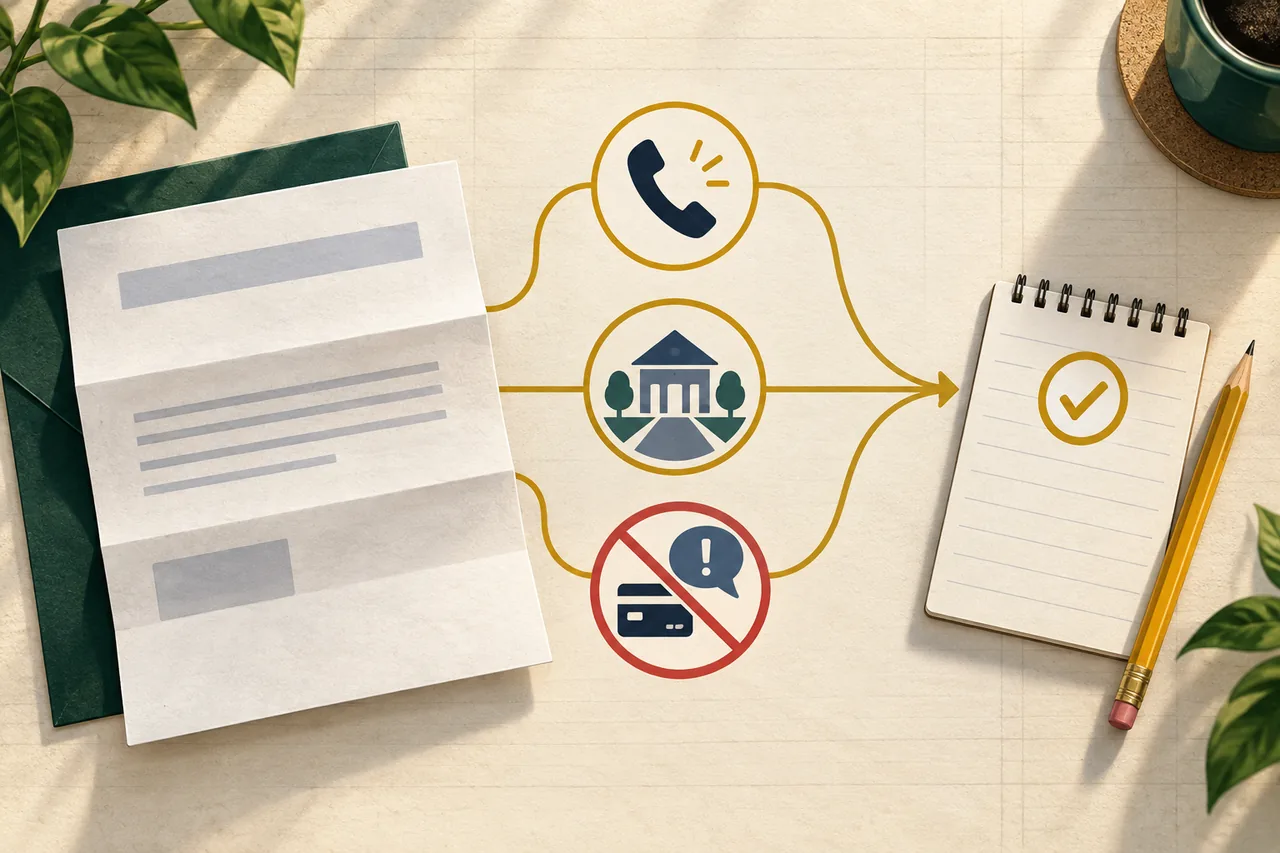
If you receive an electricity or natural-gas shutoff notice, verify it through a known company contact, confirm the exact proposed disconnection date and what could change it, then contact the utility and official assistance office promptly. Write down each answer. Do not assume a payment, dispute, or assistance application pauses the notice unless the utility or regulator confirms that it does.
What should you verify first?
Start with the notice itself. Find the utility name, account holder, service address, amount described as past due, notice date, proposed disconnection date, and any payment or dispute instructions. Compare the amount with the latest bill and recent payments. A notice can reflect a payment that has not posted yet, but do not assume that is the explanation.
Use the phone number printed on a bill you already trust or the utility contact reached from its official website. Ask the representative to confirm that the notice is real and still active, the exact amount the account shows as overdue, and the date and time service could be disconnected. If the notice lists a past date, ask whether a new date has been set. Record the person’s name or ID, time of call, and any reference number.
This is a fact check, not a decision to pay the entire amount immediately. Confirm which amount is past due, whether a recent payment or credit is missing, and what the utility says will happen next. If a written notice and the account portal show different dates, ask the utility to resolve the discrepancy and explain which date it is using.
What should you ask the utility today?
Ask for the specific next action that could keep service connected, along with its deadline. The answer may depend on the utility, your state rules, account history, and available arrangements. A general promise such as “we can work with you” is not enough to know whether a scheduled disconnection changed.
- What exact amount, if any, must be paid by what date to avoid the currently scheduled disconnection?
- Can the utility offer a payment arrangement or another option for this account? What amounts and dates would it require?
- If I apply for energy assistance, does that change the disconnection date? What confirmation or payment pledge must the utility receive, and by when?
- If I believe the balance is wrong, how do I dispute it, what amount is not disputed, and does the dispute change the scheduled date?
- Can you send the arrangement, deadline, or status update in writing through the account portal or another verified channel?
Short call opening: “I received a notice dated [date] that lists a possible disconnection on [date]. I want to confirm the account status and understand what options are available. What is the exact amount and deadline the utility is using, and what action would change the scheduled date? Please tell me how I can get that information in writing.”
Before agreeing to a payment amount, compare the dates with money you expect to have available and bills due at the same time. If a proposed plan does not fit, say so and ask what other arrangements or assistance routes are available. The call-preparation guide has general tips for clarifying terms and keeping a record. Do not describe a partial payment as a plan unless the utility confirms what it accomplishes.
Could a shutoff message be a scam?
An unexpected call, text, email, or doorstep visit demanding immediate payment to prevent a same-day shutoff is a warning sign. The Federal Trade Commission says scammers impersonate gas and electric utilities and may demand wire transfers, cryptocurrency, payment apps, or gift cards. Do not use the sender’s phone number or link to check the claim. Stop the conversation and contact the utility yourself using a number from a trusted bill or its official website.
A real written notice can still require prompt attention, so do not ignore it just because scam messages exist. Verify the notice independently. If you already paid someone who may be a scammer, contact your bank or payment provider using its official contact method and follow the FTC’s current recovery guidance.
Finding energy assistance through official channels
Start with the official USAGov energy-bill help page to find the Low Income Home Energy Assistance Program (LIHEAP) office for your state or territory. LIHEAP may help with heating or cooling costs and, in some places, other electric bills or emergency services. The federal program funds state, territorial, and Tribal programs; local rules decide eligibility and how to apply.
Contact the office promptly and ask whether it handles an active shutoff notice, what documents it needs, how to submit them, and when it can tell you the application status. A program screening is not an approval, and a submitted application is not proof that the utility changed its schedule. Ask both the assistance office and the utility how they coordinate, then get the utility’s current account status directly.
USAGov notes that each state has different rules for when electricity or natural gas may be disconnected. Weather, age, disability, and provider can matter. Use the state’s official utility regulator or the contact linked from the government resource for location-specific information. Do not rely on a general article to determine whether a protection applies to your household.
What changes if you dispute the bill or have a safety concern?
If a charge looks wrong, point to the specific line, payment, or date and ask for the utility’s dispute process and response timeline. Ask whether it expects you to pay any amount not in dispute and whether the existing disconnection schedule remains active while the issue is reviewed. Do not assume that opening a dispute automatically stops a shutoff. Write down the instructions and check the account again before the stated date.
If someone in the home depends on electricity for medical equipment, has a serious health condition, is older, or may face a weather-related risk, tell the utility and the official assistance office immediately. Ask what documentation or state-specific protection process exists and how to submit it. Do not assume a medical note, household member, or weather forecast automatically prevents disconnection. If a loss of heat, cooling, or powered medical equipment creates an immediate danger, seek local emergency help while you contact the utility.
Copy this notice-to-action tracker
- Notice: date received, amount claimed past due, proposed date, and whether the notice was independently verified.
- Utility contact: number or official channel used, date and time, representative or department, reference number, and current account status.
- Options: exact amount and deadline discussed; arrangement terms offered; disputed amount and process; assistance office and documents needed.
- Confirmation: what the utility says changes the schedule, where written confirmation will appear, and when to check again.
- Next check: calendar date and time to follow up before the utility’s stated deadline.
Hypothetical example: A fictional notice says $246 is past due. The account holder says $70 is available today, so $246 minus $70 leaves $176 unresolved. That arithmetic does not establish that $70 is enough to prevent disconnection or that a payment plan is approved. The next step is to ask the utility what that payment would do, whether an arrangement is available for the remaining amount, and how to confirm the result in writing.
For a broader plan covering several overdue bills, see the financial reset checklist and the guide to comparing bill consequences. Use those tools to organize questions, not to replace local utility rules or a confirmed agreement.
What if service has already been disconnected?
Call the utility through a verified contact and ask what amount and steps it currently requires to restore service, whether a payment arrangement or emergency assistance is available, and what fees or inspection steps apply. Contact the official state or Tribal energy-assistance office and explain that service is already off. Ask for the next update time and write down the case number. Restoration timing and eligibility depend on the provider and local program; do not rely on an unconfirmed estimate.
Sources and review note
Sources checked October 6, 2026: USAGov, Get help with energy bills (last updated January 13, 2026); HHS/ACF, LIHEAP FY2024 fact sheet; and the Federal Trade Commission, utility impersonation scams (page marked June 2026). The LIHEAP Clearinghouse state-policy pages could not be opened during research, so this guide does not summarize state-specific rules. This is general U.S. education, not legal or financial advice.
